
What does it take to create a new shoe?
On our e-shop, you see the finished shoe. You choose the colour and size, and a few days later you can already head out in it. But before a new style gets this far, it goes through months of work, sketching, sampling, testing and fine-tuning.
So how does a new style actually come to life? We spoke to our development team and followed the journey from the first idea to a shoe ready for production.
.png)
Where does the story of a new shoe begin?
It starts when work on a new collection begins. Incidentally, this can also be the point when some existing styles come to an end. It is a natural process, with old things making room for new ones.
Ideas for a new style or changes to an existing one come from many different directions. From us in the development team, from marketing and its data, indirectly from our partners and customers, or from our colleagues at Aylla.
From this flood of ideas, the ones that make it into development are those that make sense to us as designers in the context of the collection and the brand’s overall portfolio – perhaps there is a type of shoe we have been missing – while also making sense to marketing and sales from their perspective. Deciding together across teams which new shoes we are going to make is a big moment.
How does the first idea become the first real sample?
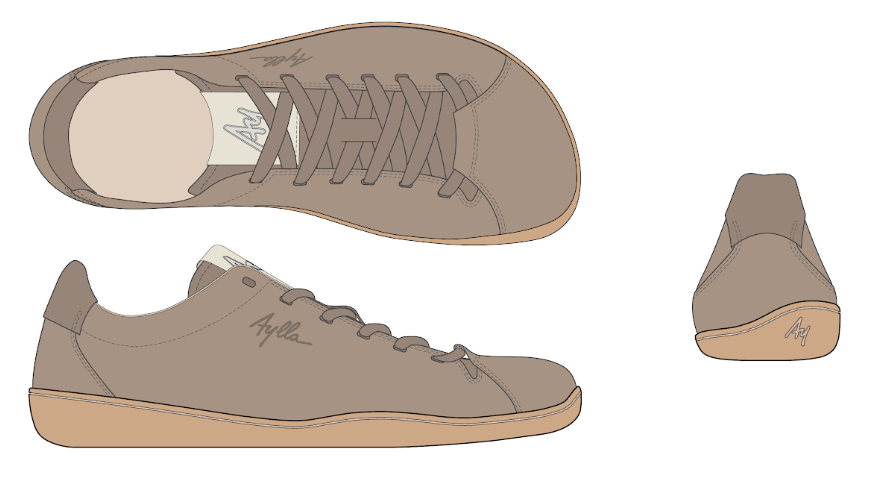
Once we have defined the brief for a new style, probably the most creative phase of the entire shoe development process begins. We sketch, assess different ideas, designs and variations, and choose materials, a colour palette and other elements.
We try to sketch the traditional, analogue way rather than digitally. Pencil on paper. We feel that certain hidden parts of the creative process can get lost in a digital environment, so we only digitise the final or almost-final drawings.
In the next stages, we often create AI visualisations, which make it easier to picture our ideas and can also help us reduce the need for costly prototype production.
The result of this phase is a digital file showing what the shoe should look like and specifying its materials, construction and other details. We share the file with our production team in Portugal, who use it to make the first sample.
What all needs to come together when developing a shoe?
We work on the cut, materials, construction, colours… The sole needs to be in balance with the upper. Everything has to work well together. With shoes, even a seemingly small detail can have a major impact on something as important as comfort.
On a broader level, we also consider how the new style will fit in alongside our existing ones. Creating a functional and good-looking shoe that is high-quality, well-priced, suitable for mass production and competitive at the same time is a small miracle involving a lot of people and a lot of decisions.
What happens when the first sample arrives?
The first sample usually requires the most work and adjustments. We compare it with the original brief we gave to production, as well as with our own experience of what works on a shoe and what does not.
Some things are obvious straight away, others only become apparent after wearing the shoe for a short while, and some emerge only after longer testing. The adjustments can generally be divided into purely aesthetic ones – for example, changing certain shapes – and functional ones, aimed at maximising comfort, usability or durability. We might adjust the padding in the tongue or make a pull tab larger, for example.
We photograph the shoe, record the changes we want and request a new sample. We repeat this process several times until we are happy with it.
How much does a shoe change during development?
Usually, not dramatically. Some details may change, but we generally keep the overall concept and DNA of the shoe from the initial design all the way through to mass production.
.jpg)
How long does the entire development process take?
From the initial research to what we call the confirmation sample – the finished shoe that serves as the reference for mass production – it takes around six months.
Of course, it depends on the complexity of the project. A facelift of an existing style takes less time, while a completely new shoe with a new sole can take longer. Sampling and testing take up the largest part of the process.
What did this journey look like for the new SUNI Trail High, which customers will soon be able to wear?
SUNI Trail High was born from the need for a non-leather barefoot hiking boot built on our new last. It was one of those bigger projects where a new sole is designed and developed specifically for the new style – in this case, our new Neo Grip outdoor sole.
It helped that we could draw on our experience and feedback from our leather MITU hiking boots. On the other hand, we had not yet worked with a textile that could handle demanding outdoor conditions while remaining as breathable as possible.
We also worked on the height of the shoe, making sure it was neither too high nor too low. Or, for example, on preventing the textile gusseted tongue from bunching up unnecessarily at the bottom.
And you will soon be able to see the result of this journey for yourself. SUNI Trail High is coming to our e-shop this autumn.